RoachRambles #002

THE MACHINE WORKS. YOU'RE JUST NOT THE CUSTOMER.
A president at 33 percent is extending a war 80 percent of Americans expect to drag on, while Washington insures immigration officers, revives Depression-era tariffs, and clears the grid for an eight-gigawatt AI furnace.
August 18, 2026
I keep coming back to the numbers.
Thirty-three percent. That is Donald Trump's approval rating, the lowest of his current presidency.
Eighty percent. That is the share of Americans who think our involvement in Iran will continue for an extended period.
One in five. That is how many think the war has been worth it.
Then the numbers get bigger. A $500,000 liability policy for local officers making immigration arrests. Half a billion dollars proposed for a youth-vaping trend that is already falling. A $105 billion corporate guarantee attached to an eight-gigawatt AI compound in Ohio. Fifty percent tariffs dragged out of a law from 1930 like somebody found economic policy buried in a cursed tomb and thought, fuck it, let's open the box.
Put those numbers next to each other and the usual story about American dysfunction starts to smell like something dead behind the drywall.
We are constantly told the government cannot do anything. It cannot move quickly. It cannot coordinate. It cannot find money. It cannot build. It cannot regulate. It cannot protect anyone because the Constitution, the deficit, the parliamentarian, the courts, federalism, procedure, tradition, Mercury in retrograde, and some senator from a state containing more cows than people all say no.
Then somebody wants to bomb a country, expand an arrest program, threaten a trading partner, or feed a private data center enough electricity to power several million homes, and would you look at that: the paperwork is already printed.
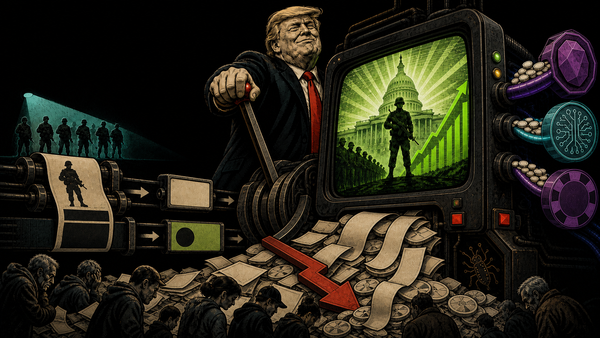
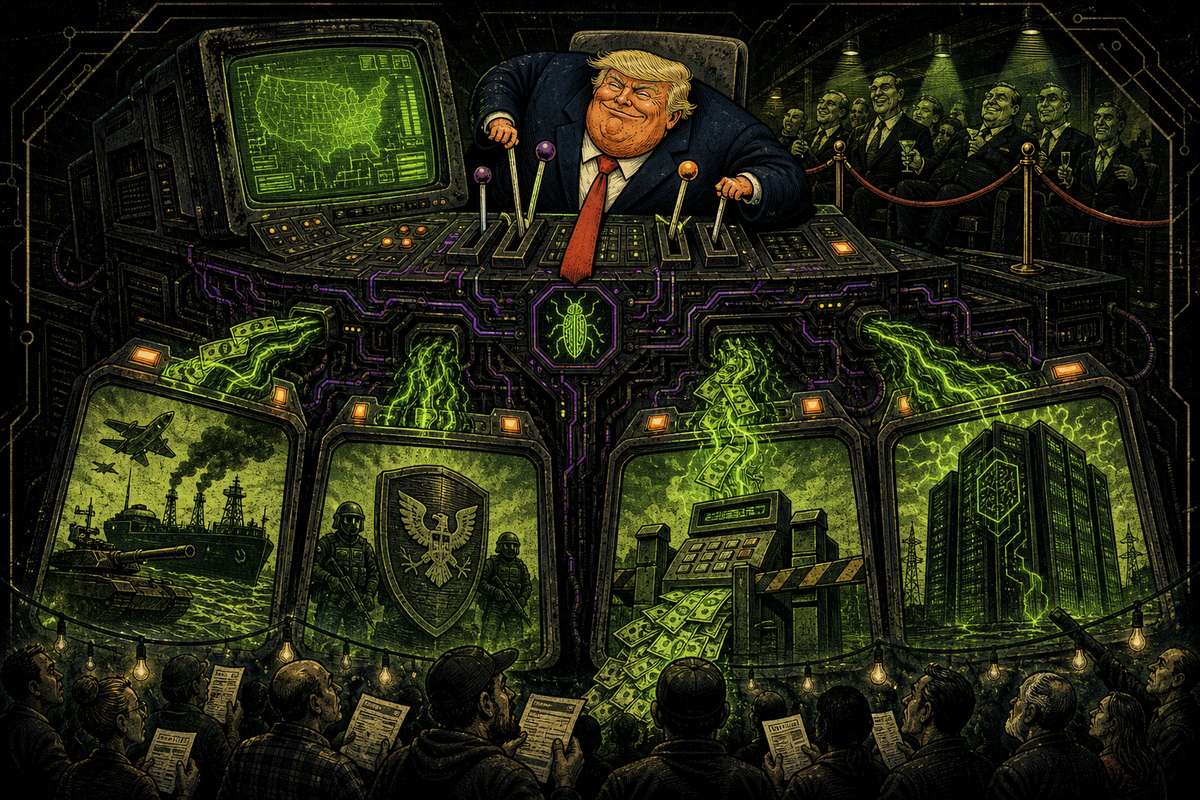
The machine is not broken.
You are just not the customer.
THE WAR HE ALREADY WON IS STILL GOING
The temporary agreement between the United States and Iran has reached its 60-day deadline without becoming a permanent peace deal. Iran is threatening to move to a "fully offensive" posture. Washington has ruled out extending the arrangement. Shipping through the Strait of Hormuz remains severely disrupted, choking a route that carried roughly one-fifth of the world's oil and liquefied natural gas before the war.[1]
This is the war that was supposed to be short, decisive, clean, brilliant, historic, probably the best war anybody has ever seen. Every few weeks the administration announces some new shade of victory while the actual conflict sits in the corner eating another shipping lane.
Donald Trump responded to Oman's attempt to negotiate shipping arrangements with Iran by threatening to "bomb the shit out of them" if they got in his way. Oman is not an enemy state. Oman is a U.S. security partner trying to perform diplomacy in a region where the American president now communicates like a gold-plated HOA president who found a cruise missile under the sink.[1]
Think about the sequence. We help start a war. The war disrupts one of the most important energy corridors on Earth. An ally tries to negotiate. The president threatens to bomb the ally. Then Americans are told the resulting fuel prices are a regrettable sacrifice for national security.
Whose security? Not the person watching another ten dollars appear on the gas pump. Not the worker whose grocery bill rises because every truck, tractor, warehouse, ship, and delivery route in the economy runs through energy costs. Not the service member being kept in the region until somebody invents a victory condition that survives contact with reality.
Trump's approval has fallen to 33 percent. Sixty-four percent disapprove. Eighty percent expect the war to continue for a long time, including 71 percent of Republicans. Only 20 percent of Americans think it has been worth the cost. Gasoline has climbed above $4 a gallon after sitting below $3 before the conflict.[2]
That is not a hostile media narrative. That is the country looking at the smoke, smelling gasoline, and correctly identifying a fire.
Trump built a political movement by pointing at the rotting remains of Iraq and Afghanistan and saying the establishment had lied, wasted lives, wasted money, destabilized entire regions, and left Americans holding the bag. He was right about much of that. Then he got the keys back and drove us into the same ditch while yelling that his ditch was deeper, stronger, and getting tremendous reviews.
"America First" has become a billing arrangement. The administration gets the war. Oil traders get the volatility. Defense contractors get the orders. You get the receipt and a lecture about patriotism.
YOUR RIGHTS NOW COME WITH A DEDUCTIBLE
Back home, Immigration and Customs Enforcement is working on a plan to reimburse local police officers for professional liability insurance when they participate in federal immigration arrests. The proposed policies could cover up to $500,000 in legal fees, settlements, and judgments arising from accusations of misconduct. ICE would reimburse each participating officer up to $250 per year.[3]
This is not immunity, and it is important not to lie about that. An officer could still be investigated, sued, or held liable. The plan would simply make that liability less personally frightening while ICE recruits local departments into the federal immigration dragnet.
Simply. There is a useful little word.
The officer gets a subsidized insurance policy in case an arrest goes catastrophically wrong. The person being arrested gets to hope that everyone involved understands immigration law, has the correct identity, is not profiling them, is wearing visible identification, has an operating body camera, and considers constitutional rights more important than pleasing the administration screaming for higher numbers.
The officer's risk gets actuarial tables. Your risk gets a case number and hold music.
Professional liability insurance is not inherently outrageous. Doctors carry it. Teachers carry it. Engineers carry it. A false allegation should not destroy somebody's life merely because they wear a badge. Fine.
But where is the matching machinery for the public?
Where is the rapid compensation system for wrongful detention? Where is the automatic outside investigation when an officer conceals their identity? Where is the national database of substantiated civil-rights violations? Where is the mandatory reporting on citizens detained during immigration operations? Where is the policy guaranteeing legal representation to the person who just disappeared into a federal processing system because an officer made a mistake at two in the morning?
Protection for the people enforcing the policy arrives as a procurement proposal. Protection from the people enforcing it remains a campaign promise.
That is the entire administration in miniature. Power gets equipment, money, contractors, insurance, and the presumption of good faith. Everybody beneath it gets told that if nothing illegal happened, they have nothing to worry about.
There are few sentences in the English language more reliably followed by something illegal happening.
WON'T SOMEBODY THINK OF THE CHILDREN, SELECTIVELY
The public-health numbers are somehow more insulting because we are asked to pretend they point in the opposite direction.
Kindergarten vaccination coverage fell again during the 2025-2026 school year. Coverage for measles, mumps, and rubella is now 92.4 percent, below the 95 percent threshold the CDC says is needed to prevent outbreaks. Vaccine exemptions rose from 3.6 percent to 4.2 percent, increasing in 41 states and Washington, D.C. The United States has recorded 2,566 measles infections this year, the highest number in more than 35 years.[4]
Those are not speculative harms. Those are sick people. That is a disease we know how to prevent walking back through the front door because the country left it open and put up a sign saying PERSONAL CHOICE.
Trump's response was to sign an executive order calling for fewer childhood vaccinations and recommending that the combined MMR vaccine be split into three shots administered during separate visits.[4]
Vaccination is already becoming less common, so naturally the solution is to make it less convenient. Perhaps the next executive order can require parents to visit three different pharmacies, defeat a regional manager in ritual combat, and retrieve the final dose from a CVS receipt stretching across state lines.
Congress, meanwhile, has located a different emergency. The proposed PROTECT Act would authorize $100 million per year for five years for youth-vaping research, grants, policy development, and prevention.[5]
Let me make the part that will inevitably be clipped out very clear: teenagers should not vape. Nicotine dependence is real. Companies should not market flavored addictive products to minors. The FDA says 5.2 percent of middle- and high-school students, about 1.44 million young people, currently use e-cigarettes. More than one-quarter of current youth users vape daily, and nearly nine in ten use flavored products.[6]
Enforce age restrictions. Hammer companies that knowingly sell to children. Fund cessation programs for teenagers who are already dependent. Do all of that.
But stop calling a decline a rise.
The FDA's own data says youth use of cigarettes, e-cigarettes, and tobacco products overall fell from 2022 through 2025.[6] The problem still exists. The trend is nevertheless moving in the correct direction. Both facts fit inside the same human skull unless that skull is currently writing a grant proposal.
So here is the federal priority stack. Childhood vaccination is falling. Exemptions are rising. Measles is at a 35-year high. The administration answers by encouraging a more fragmented vaccination schedule. Youth vaping is also falling. Congress answers with a half-billion-dollar bill marketed as a response to a dangerous rise.
The government is looking at one line going down and calling it an emergency, then looking at another line going down and helping it descend.
That is not public health. That is a Ouija board wearing a lab coat.
Cannabis policy ran this scam for generations. Find a genuine risk, inflate it until suburban parents begin seeing assassins in the wallpaper, ignore every distinction between use and abuse, and build an enforcement empire whose budget depends on never admitting the original panic was exaggerated. Psychedelics got the same treatment. Nicotine policy is currently standing in the parking lot jingling the keys to the same clown car.
Protect children. Tell adults the truth. Distinguish vaping from combustible cigarettes without pretending either is oxygen. If officials cannot explain risk without lying about their own trend line, they are not practicing public health. They are selling a franchise.
THE FREE MARKET HAS A VIP ENTRANCE
The Trump administration's economic doctrine is foreign policy with a cash register: threaten everybody, demand tribute, then describe retaliation as an unprovoked attack.
The United States and Canada are holding last-minute talks over 50 percent tariffs affecting roughly $20 billion in Canadian goods. Trump invoked Section 338 of the Tariff Act of 1930, a provision that has never been used before and permits tariffs of up to 50 percent without an investigation or a time limit.[7]
Nineteen thirty. The administration went grave-robbing through the Smoot-Hawley era, found an unused economic cudgel under Herbert Hoover's coffin, and decided this was the innovation American consumers had been waiting for.
Tariffs are collected from importers. Foreign producers may absorb some of the cost, but American businesses and consumers often pay through higher prices, damaged supply chains, reduced competition, and lost export markets when the other country punches back.
Canada is our neighbor, ally, and one of our largest trading partners. The administration treats that relationship like a pawn shop dispute because everything in Trump's world has been reduced to leverage. Trade is leverage. Security cooperation is leverage. Market access is leverage. Alliances are leverage. A handshake is apparently what happens before one party checks whether the other still has a wallet.
Try running an actual business inside this genius casino. Price a product when tariffs can jump according to the president's mood. Negotiate a supply contract when a dormant law from 1930 can be revived without an investigation. Build a factory when the largest integrated trading relationship on the continent is being managed like an argument between two divorced uncles over a fishing boat.
And while ordinary commerce gets the cattle prod, the largest technology firms enter through the velvet rope.
Nvidia has agreed to guarantee up to $105 billion to support OpenAI's lease of a massive Ohio data center being developed by SoftBank-owned SB Energy. Nvidia will invest another $1.5 billion in the developer and become the facility's exclusive chip supplier. The site could eventually consume eight gigawatts of electricity. One gigawatt, Reuters notes, is enough to power roughly 750,000 American homes on average.[8]
Do the scale in your head. Eight gigawatts is not a server closet. It is not a startup campus. It is a regional industrial organism squatting beside the power grid with its mouth open.
Nvidia says the arrangement is not circular financing. Maybe the economics are sound. Maybe demand justifies the scale. The project could create thousands of construction jobs and valuable computing capacity.
It is still the chip supplier investing in the developer, guaranteeing part of the customer's lease, securing exclusive demand for its own chips, and projecting enormous future revenue from the loop.[8] That deserves more scrutiny than Jensen Huang saying trust me while a Silicon Valley ouroboros eats a GPU invoice the size of Belgium.
Who upgrades the grid? Who secures the water? Who gets priority when electricity becomes scarce? Who pays if local infrastructure buckles? Who owns the upside if the facility prints money? Who holds the bag if the AI market discovers that infinite capital expenditure is not the same thing as infinite demand?
Those are not anti-technology questions. They are the questions adults ask before allowing a private project to consume electricity on the scale of millions of homes.
American capitalism now has two entrances. Small businesses, importers, farmers, manufacturers, and consumers line up outside for tariffs, uncertainty, and patriotic lectures about sacrifice. The trillion-dollar technology class glides through the VIP door with financing guarantees and a dedicated substation.
The market is free. Some customers are simply freer than others.
THE REMAINING ADULTS HAVE FOUND THE WORD “NO”
There are still a few institutions capable of refusing power. Not often enough. Not quickly enough. But enough to prove the word remains in circulation.
The Supreme Court rejected Trump's second attempt to reopen the $5 million E. Jean Carroll judgment. A jury found him liable for sexually abusing and defaming Carroll, and that verdict is now final. The court is separately considering whether to hear his challenge to another $83.3 million defamation verdict.[9]
In California, Meta is facing a federal trial brought by California, Colorado, Kentucky, and New Jersey over alleged harms to children. The states accuse the company of deliberately designing addictive features and collecting data from children under 13 without parental consent. They seek financial penalties and changes to Facebook and Instagram. Meta disputes the allegations and says it has invested in protections for younger users.[10]
Do not mistake this for a healthy accountability system. Trump remains president. Meta remains one of the most powerful communications companies ever assembled. Money and office still buy legal battalions, procedural mazes, appeals stacked on appeals, and a luxurious version of due process that poor defendants mostly encounter in civics textbooks.
Still, a consequence arriving late beats a consequence being escorted out through the service entrance.
The more dangerous pattern is the insistence that every restraint is illegitimate. A court rules against the president, so the court is corrupt. A regulator constrains a corporation, so regulation is tyranny. A journalist publishes a fact, so journalism is treason. An ally negotiates independently, so the ally is disloyal. A citizen records an arrest, so the citizen becomes suspicious.
Power will tolerate process right up until process produces the wrong answer.
Then the masks come off and the only acceptable answer is yes.
That is not confidence. It is the emotional stability of a shopping cart with one bad wheel, except the cart has federal agents and nuclear weapons.
READ THE NUMBERS AGAIN
Thirty-three percent approval.
Eighty percent expecting a long war.
One in five saying the war was worth it.
A $500,000 liability policy to make federal immigration enforcement more comfortable for local officers.
A half-billion-dollar response to a youth-vaping trend that is declining while measles hits a 35-year high.
Fifty percent tariffs pulled from 1930.
A $105 billion guarantee for an eight-gigawatt AI facility.
These are different stories. They are not evidence of one secret committee sitting beneath Washington in matching robes. They do not need to be.
They reveal the same public hierarchy without anybody coordinating it.
Power is centralized. Responsibility is outsourced.
The White House starts a war, and drivers absorb the fuel bill. ICE expands local enforcement, and communities absorb the civil-rights risk. Washington starts a tariff fight, and consumers absorb the prices. Technology companies build private industrial empires, and the public grid absorbs the load. Vaccination becomes ideological, and children absorb the disease.
Then the people responsible walk to a podium and explain that government is powerless.
No, it fucking isn't.
It is busy.
It is busy protecting the people who execute policy from the consequences of executing it. It is busy manufacturing leverage over allies and trading partners. It is busy clearing infrastructure for companies whose financing structures contain more zeroes than some national economies. It is busy finding fresh emergencies to fund while measurable crises rot directly beneath the press-release podium.
The old argument about big government versus small government is useless. The government is already enormous. The only serious question is whom it becomes enormous for.
For war, policing, executive discretion, and concentrated capital, it is Godzilla in a flag pin. Ask it for competent public health, affordable care, civil-rights accountability, or protection from costs created by its own decisions, and suddenly it becomes a frightened libertarian accountant hiding under the desk with the Constitution.
America does not need a government too weak to act. Weak public power leaves private power unanswerable and enforcement power arbitrary.
America needs a government with different customers.
Until then, stop calling the machine broken.
The machine works beautifully.
Just not for you.
-Sources-
[1] https://www.reuters.com/world/middle-east/iran-threatens-go-offensive-strait-hormuz-if-diplomacy-with-us-fails-2026-08-17 — Iran threatens new offensive while US rules out extending ceasefire deal
[2] https://www.reuters.com/world/us/trump-approval-falls-33-lowest-his-presidency-reutersipsos-poll-finds-2026-08-17 — Trump approval falls to 33%
[3] https://www.reuters.com/legal/government/us-ice-puts-forward-insurance-plan-protect-local-officers-making-immigration-2026-08-18 — ICE proposes liability insurance reimbursements for local officers
[4] https://www.reuters.com/business/healthcare-pharmaceuticals/us-kindergarten-vaccine-coverage-falls-cdc-says-2026-08-17 — US kindergarten vaccination coverage continues to fall
[5] https://floridianpress.com/2026/08/debbie-wasserman-schultz-reintroduces-legislation-tackling-youth-vaping — PROTECT Act proposes $500 million for youth-vaping programs
[6] https://www.fda.gov/tobacco-products/youth-and-tobacco/results-annual-national-youth-tobacco-survey-nyts — FDA: 2025 National Youth Tobacco Survey
[7] https://apnews.com/article/tariffs-trump-canada-usmca-trade-aae597c22617bec7a99f670a2c787ef9 — US and Canada seek to avert 50% tariffs on $20 billion of goods
[8] https://www.reuters.com/business/media-telecom/nvidia-invest-15-billion-sb-energy-under-openai-data-center-deal-2026-08-17 — Nvidia guarantees up to $105 billion for OpenAI Ohio data center
[9] https://www.reuters.com/world/us-supreme-court-again-rebuffs-trump-5-million-e-jean-carroll-case-2026-08-17 — Supreme Court again rejects Trump appeal in E. Jean Carroll case
[10] https://apnews.com/article/meta-facebook-social-media-trial-oakland-32e8f19738eb77ab832e0f084dd677af — States take Meta to trial over harms to children